Wednesday, July 25, 2012

Using the Little Details

Click for a closer view of listed areas and details.
Johnny Cupcakes did a great job on the ice cream packages such as the sense of volume. Also, look at the suggested pressed lines in the ends. You get a sense of texture, making the image seem more tangible.

I appreciate that little detail because I do not enjoy reading descriptions that stray from the story too much and disrupt the flow.

For example, in I Robot: To Protect, the amount of detail given to food annoyed me most during a conversation. The narrator stated delight in the person on this date, but her attention was more on the food. Each described bite felt like a tree in my way as I tried to follow the conversation's direction.

Therefore, I try to describe to illustrate a character's feelings or to set the tone. If I describe to help the reader imagine an object, then giving tangible details like Johnny's pressed lines help the reader remember having felt the object before. Kudos to you if your readers feel as if they have held that object without having touched or seen it before.

The only thing I would change in Johnny's image is to make an edge of the package bend. This detail makes the representation less perfect, but more familiar. He wanted perfect symmetry though. Plus the package bend can draw your eye away from the main content.

Thank you to my sister for the Snickers ice cream bar at this moment. Now for ice cream that I can actually experience.


Sunday, July 8, 2012

Cancer Walk

My sister is on the left.
My younger sister, Therese, is participating in the Susan G. Komen breast cancer walk in November. She is participating because family members have had cancer--for two of them it was breast cancer.

If you'd like to donate, then Therese's page is HERE. Donations can be made online or by phone.

Donations are tax-deductible, but you have to put your name instead of 'Anonymous." Double check with you tax adviser though. You will receive an email receipt.

No cash donations. International donations are accepted only by credit card.

Thank you for donating or sharing Therese's page. =)

Saturday, June 16, 2012

Love Me, Stalk Me

When I read The Merchant's Daughter (2011), I told my sister, "I like that this book shows stalkers as bad." She replied, "Stalkers are bad." I clarified that my point was that the book portrays them that way.

Why do some love stories (even in genres other than Romance) depict stalking as flattering and romantic? A 1st person perspective narrator can show other characters to the reader by stalking them, but even detectives face trouble for doing so. Stalking is a wrong kind of attention. A pet peeve of mine is when the fictional love interest has no social life, job, or actitivies so he can attend to the main character 24/7 and rescue if necessary. That love interest usually stalks.

By the way, The Merchant's Daughter is a spiritual retelling of Beauty and the Beast. The author Melanie Dickerson explored appearances as well as love vs. lust (with stalking). Some lines were repetitive and some problems disappeared at the end, but I still liked the book. The setup is more like Jane Eyre in terms of servant and Lord.

A common conflict or climax for heroines is kidnappings. I do not mean just for romances. Heroines tend to be threatened personally more often than male heros, who have battles, obstacles, time-limits, or his beloved is threatened. My concern is for readers getting the wrong idea of romance and for more developed storylines for heroines.

Let's look through classic film monsters for women stalked or kidnapped (spoilers):
Frankenstein's Monster: He observes humanity. He stalks the Frankensteins and kills a woman, but for revenge against Dr. Frankenstein.
Dracula: Stalks, kills, and tried/succeeded in kidnapping depending on version.
The Mummy: Stalks and kidnaps.
Swamp Thing: Stalks and kidnaps.
Phantom of the Opera: Stalks and then later kidnaps.
King Kong: She's kidnapped by a tribe as sacrifice. Later Kong kidnaps her.
King Kong 1933
Sidenote: I roll my eyes at the King Kong line, "It was Beauty that killed the Beast." Let's not blame the ones who brought him to the city. That she-devil. Looking sexy in a torn-up dress and screaming to show off those pearly-white teeth. 
Some viewers find the stalking monsters as exciting in the romantic sense. Yes, the monster is drawn strongly to the girl, but no matter the degree of passion it is the antagonist. Yes, the woman is desired, but why must her life be threatened for attraction? Not all passions are romantic.


Those were old examples, but these type of stories still exist. Look at contemporary books of urban fantasy, dark romance, and supernatural romance. How many of them have the heroine stalked, kidnapped, in danger of rape, and/or forced to date/marry?

Another book I read for my Beauty & the Beast research was The Hollow Kingdom (2006) (some spoilers). It is divided into 3 sections. The first section has stalking and kidnapping.
Me: I like that this book shows kidnapping as bad.
Sis: Kidnapping is bad.
Me: I know kidnapping is bad.
Sis: I'm glaad you do.
Me: I mean they don't make it romantic. Like some books do. It justifies the kidnapping, but it's still bad.
Sis: They justify it?!
Me: Yeeeah.. but it's shown still as bad. The goblins don't care--which is bad--because they do it to survive. Instead of the author turning the kidnapping around as romantic. It's still bad.
Stalked girl does not look happy.
Does stalking make her more
desirable or pretty?
The heroine sort of changed her situation from being kidnapped by agreeing to it, but she did not want that living arrangement. Her reluctance is still prominent in the story. The kidnapping is showed still as bad by learning how terrifying the situation would have been if she was still a reluctant bride. Her situation is still awkward and sad though.


Eventually, the girl fell for the goblin kidnapper (kind of just happened), , Some reveiwers called it Stockholm Syndrom.


Fortunately, kidnapping is not the only exciting event in the book. The heroine got a chance to prove herself in the third section. I liked the protective charm. In addition, the author turns the arrangement around through changed perspective, which I will cover in another post.


The Hollow Kingdom was still a good example of a new bride's fears in my Beauty & the Beauty research. I recommend having that thought in mind while reading the book. The Merchant's Daughter is the healthier love story.

What do you think of this topic or The Hollow Kingdom?

I saw this image on Facebook just as I finished writing:

Saturday, June 2, 2012

Rape Myths & Stats

3 of the last 4 movies for my family's movie night had a rape--Woody Allen's movie was the exception. Most of the rapists were not a stranger to the girl. Stats show that this is often the case, but it is still surprising.

Some years ago, I spoke to two high school reluctant readers for my English Education class. Once again to my surprise, most of the books on their recommended reading list had racism, violence, and rape. 

A friend recently shared an article that proved rape advice in "Through a Rapist's Eyes" as wrong information that leads a girl's suspicion away from the most common locations and perpetrators of rape. The fact is, "70-80% of rapists are well known to their victim." The article is worth sharing. Thank you to my friend for sharing it.

The article also argues that victims of rape are usually blamed and have the hardest time proving the crime than with other crimes.

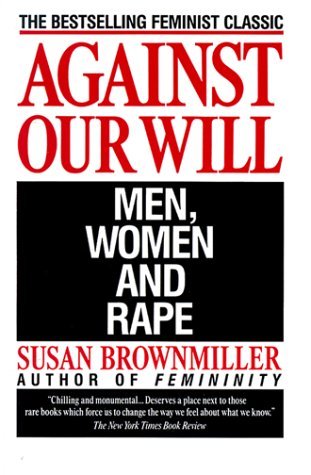
Published in 1975.
And finally, I researched some fairy tales this last semester. For "Little Red Hiding Hood," I came across Against Our Will: Men, Women and Rape. The author, Susan Brownmiller, helped organized conferences on rape in the 1970's. As a journalist, she investigated rape in newspapers, media, and crime stats. On her book, Newsweek stated:
The most comprehensive study of rape ever offered to the public...It forces readers to take a fresh look at their own attitudes toward this devastating crime.
One aspect Brownmiller brought to light was that rape is an act of power that "[keeps] all women in a state of fear." One argument against the book is that men can fight in the cause too.

I will share other aspects of my fairy tale research as well. Thanks for reading this blog post.

Saturday, May 26, 2012

The Best Story Structure

One of my favorite teachers advised to make character development the structure instead of following structure formulas. By page blah blah blah have an explosion.

The class was for screen adaptation, but the advice applies to any story. =) I improved the beginning of a story by working on the characters' journeys and goals.

Another screenwriting teacher did not believe in writer's block. She suggested to check if you strayed from the story's path at one point. Perhaps you put in a scene for its own purpose instead of the whole story's purpose. Sometimes you have to let go moments or lines. Save the draft though because you could try using that scene in another story.

Screenwriter Nicholas Meyer wanted to express his dislike of punk rock music through the time-traveling hero in Time After Time. Meyer had to omit the scene, but he rewrote it in Star Trek IV: The Voyage Home. I found the well-known scene, but the song was changed:


Friday, May 25, 2012

I'm with the Mockingjay

I heard some readers felt emotionally-drained from Mockingjay, the 3rd book of The Hunger Games. I enjoyed it because it had concepts similar to Nineteen Eighty-Four. =) Catching Fire was the emotionally-draining book for me. I felt that Katniss was weighed down by her worries.

There's some spoilers in this post even though I indirectly talk about them.

In the drawing, I wrote vague terms for what I thought were Katniss' main worries in each book before the games. I added trees because nature is her relief. With each book, she is more cut off from it. Dystopic societies usually cut people off from nature or see it as too wild.

Also this series shows nature used as and altered into a weapon. However, nature continues to live as if independent from the story's events. Man suffers and struggles to survive because of man.

I have a drawing tablet now.
I'll try quick sketches to illustrate points.
 In The Hunger Games, Katniss was a survivor but she was numb. Her main focus and devotion was her family's survival.

At this point, she doesn't know that other districts suffer just as bad or worse. Her own district has had worse days, which the adults recall.

In Catching Fire, she should no longer have to worry about her family, but Snow proves that fact wrong and adds more worries to her list. Katniss fears even her own actions and the interpretations of her actions because of consequences.

For fans of the love story/love drama, the second book seems to be their favorite.

I feel that Katniss had the most spirit in Mockingjay. She rebelled at almost every moment. She wants to be more informed on situations. She acts more than fearing on acting. Because of this strong spirit, I was not shocked at her move during the peace ceremony.

I had hoped for that move because the leaders fit George Orwell's attitude in  Nineteen Eighty-Four  that all parties are the same. The people still had to trust a leader blindly. Some people still feared for their lives. Daily life was controlled by the leader. The rebel society still lacked humanity. In the final conference, Katniss states that things are still the same.

I could not think of a right replacement for Snow, but when author Suzanne Collins showed the final leader, I agreed strongly with the choice. That person had showed interest in the people and had suffered from the Capitol.

Mockingjay is perfect...if you expect a dystopia. The first book had the dystopic setup, but was told as an adventure thriller. The second book is the transition to dystopic. Mockingjay is the dystopia of the series. I felt that Collins held back themes and attitudes in the other books. Mockingjay explains the society such as the careers in the games. This book may be my favorite of the three because of these reasons. The first book is still a great example to me of constant conflicts and the audience's influence.

I say perfect, but the book is not flawless.

The reader may get confused when the pace is too fast for storytelling near the end, but you are put in Katniss' position. You feel the rushed moment as she does.

The ending is short and quick, but I am fine with that. Although I read the book over a week instead of a few days like some readers, I needed the story to end already. You feel burnt up by the events and need relief from the tension. I recommend stopping once in a while because of the numerous events and their impact.

If you have not read  Nineteen Eighty-Four, then I recommend doing so including the prologue or section about George Orwell. I was just told that the districts and Capitol in The Hunger Games are similar to Brave New World. I bought a copy, but I'm taking a break again from dystopias.

Friday, April 27, 2012

More Hunger Games Goodies

I've been a bit restless this week, partly because I not getting out of work late anymore. Therefore, I started reading Mockingjay, the third book of The Hunger Games. I have less than 30 pages left. I will discuss after I finish it, but right off the bat I enjoyed how dystopic this one is.

Meanwhile, here are some related goodies to share. =)

At first I thought Peeta was a Butcher. My favorite are Katniss, Cinna, and Effie. haha. 


This mix makes me love the people who create memes. Hahaha. Effie has popped up a lot in them. Here's a similar one:
Whoever did better not answer because he/she was selected.


The boys from the musical parody "Bake You Pies" worked again for a more serious video, "The Arena". Some events from the movie are depicted.