Showing posts with label danger. Show all posts

Saturday, March 9, 2013

The Monster & the Victim

This year I started using Pinterest for project references. For parody posters and a story, I have a board for Old Horror Posters. Sometimes I found that the Italian posters focused more on the horror than sex appeal. I wanted to talk about images for Creature From the Black Lagoon (Movies from the 50s had longer titles).

First, here's the trailer: 


One of my screenwriter instructors said that a common theme for old horror movies was the monster trying to be human. One way was to impregnate a female human so that its offspring will be more human. In Creature From the Black Lagoon, fish evolved to a stage where it thinks itself compatible for our women. We are divided as us and them, but they want to be more like us. I'm sure you can think of more movies with those lines of thoughts and outside of monsters.

Back to movie posters


It has claimed her as its mate.
You may be next!
I'm not sure if the image on the right is an official movie poster, but let's start off with it. I like the scene and close-up, but also how much the image evokes is why it is my favorite representation for Creature From the Black Lagoon. :)

For example, the water level reminds us of the dividing line between monster and human and between danger (monster's territory) and safety (our territory). The high water level could show how the monster is spilling onto our side. Another interpretation could be the far distance the monster came from and the distance the hero will have to travel to rescue the victim. The swimmers seem to still search for both monster and victim.

In old horror posters, kidnapped women are either screaming or asleep, the damsel's version of fight or flight. Unconsciousness makes them helpless in the situation.

Another one of my professors commented on how sleeping or dead females in media are portrayed as attractive because they are most docile in those states. We discussed fairy tales and Orphelia in Shakespeare's MacBeth.

Disney's Sleeping Beauty
Most sleeping beauties are in wait for their prince and first kiss. Thus, the horror when they wake to find a monster grabbing at them instead. Some females faint from the shock, keeping them in that helpless state and continue hoping their prince will come.

Although I could not finish reading Spinning Straw into Gold because of the poor flow and structure, I was impressed with Joan Gould's discussion of sleep as an emotional defense of distance. These women try to escape internally (mind and emotions) while leaving their external (body) in the threat, but they do so in wait for when their internal is ready for the situation. Gould gave a real life testimony as an example.

Now for the Faceless


It wants to save her from
the man and his knife!
The image on the right is the Italian poster for Creature From the Black Lagoon. We cannot see the monster's face, but we see the fear on both human figures. The faceless monster matches the fear of the unknown referenced in the trailer.

However, the man looks threatening too by grabbing the woman with a knife in the same hand. He is no real threat so the purpose is to portray him as the non-princely mate with sex appeal and protection.

The woman is kept awake to face her threats, but we feel a safe distance by having the monster's focus entirely away from us. Still we feel so closely behind that it may hear our footstep. We wait in suspense for when we do come face to face with the threat. 

After the last two posters, I was disappointed when I saw the following image down below. :( I think it is a book cover.

It has brought home the meat.

This time we cannot see the woman's face. When a figure's face is cut off, covered up, or exaggerated like in propaganda, the figure has been dehumanized. We cannot see the woman's identity and emotions, but we have a clear shot of her sexy lower body. She has been reduced to flesh. The viewers see her as the monster does.

There is not much else for our focus. The rest of the image shows the danger of the monster already having her in its hidden lair. The woman in this image is closer to becoming a victim of more than kidnapping. Her potential saviors and her territory are nowhere in sight. Sadly, missing a face makes it harder for us to connect with her. We feel we don't know her. We don't even know if she is unconscious or dead.

Don't you feel more sorry for the screaming face on the DVD cover below?

It has stolen one of our own!
In each image, the woman looks sexy. Sexy enough to even make the monster attractive for finding her desirable. Her reaction on the right shows best that his behavior is unwanted and dangerous. Despite how much he has evolved, his behavior has not progressed enough to be her equal.

I don't always like the role of women in old horror movies, but I find the themes and ad designs interesting. Sometimes it can all be ridiculous enough to laugh. From what I discussed in this blog, women seem to be the measure of danger, humanity, and good breeding. The monster can be found in our species as well.

Saturday, June 16, 2012

Love Me, Stalk Me

When I read The Merchant's Daughter (2011), I told my sister, "I like that this book shows stalkers as bad." She replied, "Stalkers are bad." I clarified that my point was that the book portrays them that way.

Why do some love stories (even in genres other than Romance) depict stalking as flattering and romantic? A 1st person perspective narrator can show other characters to the reader by stalking them, but even detectives face trouble for doing so. Stalking is a wrong kind of attention. A pet peeve of mine is when the fictional love interest has no social life, job, or actitivies so he can attend to the main character 24/7 and rescue if necessary. That love interest usually stalks.

By the way, The Merchant's Daughter is a spiritual retelling of Beauty and the Beast. The author Melanie Dickerson explored appearances as well as love vs. lust (with stalking). Some lines were repetitive and some problems disappeared at the end, but I still liked the book. The setup is more like Jane Eyre in terms of servant and Lord.

A common conflict or climax for heroines is kidnappings. I do not mean just for romances. Heroines tend to be threatened personally more often than male heros, who have battles, obstacles, time-limits, or his beloved is threatened. My concern is for readers getting the wrong idea of romance and for more developed storylines for heroines.

Let's look through classic film monsters for women stalked or kidnapped (spoilers):
Frankenstein's Monster: He observes humanity. He stalks the Frankensteins and kills a woman, but for revenge against Dr. Frankenstein.
Dracula: Stalks, kills, and tried/succeeded in kidnapping depending on version.
The Mummy: Stalks and kidnaps.
Swamp Thing: Stalks and kidnaps.
Phantom of the Opera: Stalks and then later kidnaps.
King Kong: She's kidnapped by a tribe as sacrifice. Later Kong kidnaps her.
King Kong 1933
Sidenote: I roll my eyes at the King Kong line, "It was Beauty that killed the Beast." Let's not blame the ones who brought him to the city. That she-devil. Looking sexy in a torn-up dress and screaming to show off those pearly-white teeth. 
Some viewers find the stalking monsters as exciting in the romantic sense. Yes, the monster is drawn strongly to the girl, but no matter the degree of passion it is the antagonist. Yes, the woman is desired, but why must her life be threatened for attraction? Not all passions are romantic.


Those were old examples, but these type of stories still exist. Look at contemporary books of urban fantasy, dark romance, and supernatural romance. How many of them have the heroine stalked, kidnapped, in danger of rape, and/or forced to date/marry?

Another book I read for my Beauty & the Beast research was The Hollow Kingdom (2006) (some spoilers). It is divided into 3 sections. The first section has stalking and kidnapping.
Me: I like that this book shows kidnapping as bad.
Sis: Kidnapping is bad.
Me: I know kidnapping is bad.
Sis: I'm glaad you do.
Me: I mean they don't make it romantic. Like some books do. It justifies the kidnapping, but it's still bad.
Sis: They justify it?!
Me: Yeeeah.. but it's shown still as bad. The goblins don't care--which is bad--because they do it to survive. Instead of the author turning the kidnapping around as romantic. It's still bad.
Stalked girl does not look happy.
Does stalking make her more
desirable or pretty?
The heroine sort of changed her situation from being kidnapped by agreeing to it, but she did not want that living arrangement. Her reluctance is still prominent in the story. The kidnapping is showed still as bad by learning how terrifying the situation would have been if she was still a reluctant bride. Her situation is still awkward and sad though.


Eventually, the girl fell for the goblin kidnapper (kind of just happened), , Some reveiwers called it Stockholm Syndrom.


Fortunately, kidnapping is not the only exciting event in the book. The heroine got a chance to prove herself in the third section. I liked the protective charm. In addition, the author turns the arrangement around through changed perspective, which I will cover in another post.


The Hollow Kingdom was still a good example of a new bride's fears in my Beauty & the Beauty research. I recommend having that thought in mind while reading the book. The Merchant's Daughter is the healthier love story.

What do you think of this topic or The Hollow Kingdom?

I saw this image on Facebook just as I finished writing:

Thursday, April 5, 2012

I Saw The Hunger Games

Last Friday, I saw The Hunger Games movie. I liked it, but I worry if people will understand some scenes. My friends who did not read the books missed the new situation at the end of the movie. Although characters smile at that point, listen to what is said in private!

I am glad that I read the first two books before the movie so that I knew the details and connections. It is hard for me to picture how much of the story I would have grasped without the book. Thankfully, some game explanations from Katniss' thoughts in the book were given in another manner.

I will be vague in further discussion of the movie to avoid spoiling it. However, I will first discuss my disappointment in The Watchmen adaptation for comparison. The trailer is down below.

Reaction to The Watchmen Adaptation First

I read The Watchmen comic shortly before the movie release. Here is the trailer for it.
During the movie, I laughed and was entertained, but afterwards I felt disappointed in the adaptation for these reasons:

  • The state of the world was not depicted enough. In the comic the second Silk Spectra helped portray the society at least through her addiction.
  • There is no distinction made between superheros and masked vigilantes.
  • Heroes that did not severely harm or kill, like Silk Spectra, plunged a knife into a mugger's throat. In the comic, the heroes who take lives are the ones who have a different state of mind.
  • Does the viewer question the consequences that the heroes reluctantly accept?
I do not detest every change made in an adaptation. For example, I have no problem with the change in the S.Q.U.I.D. Because years have past since I first saw the movie, I would now watch it a second time. Some scenes were great to see on the screen.

Back to The Hunger Games

The movie was a good introduction to Katniss' world. Some great scenes were left out of the movie, but I think key moments for characters were kept such as when Thresh speaks in the game and Cinna's influence. I was not disappointed. Some of you may be if you expect love drama.

Before the movie, I read an article on the decision to tone down the violence, which the director felt was unnecessary for the main message and characters. I agree. Anyone who hungered for more violence has not grasped that the game is actually an instrument not entertainment. The anticipation of the game and the game itself are exciting, but remember its purpose and meaning. Violence is not action. Do you mean conflict or confrontations that can be an opportunity for character growth instead?

I was surprised that the terror and danger were toned down too. I think young audiences could handle a little more of both. The focus was appropriately placed on the main danger, the Capitol. Each book because harsher though. Will the rating stay at PG-13?

To me the book was a suspenseful adventure while the movie was more on the dystopic world. When Kato has the sword, I thought of Roger in Lord of the Flies. I can see that aspect as enough terror for some minors.

Some parts before the game felt slow to me, but my coworkers who did not read the book said the beginning was fast for them. After all, they did not know the setting and characters yet. Come to think of it, I did not linger on questions with the movie's pace. So I guess the first half of the movie was not slow.
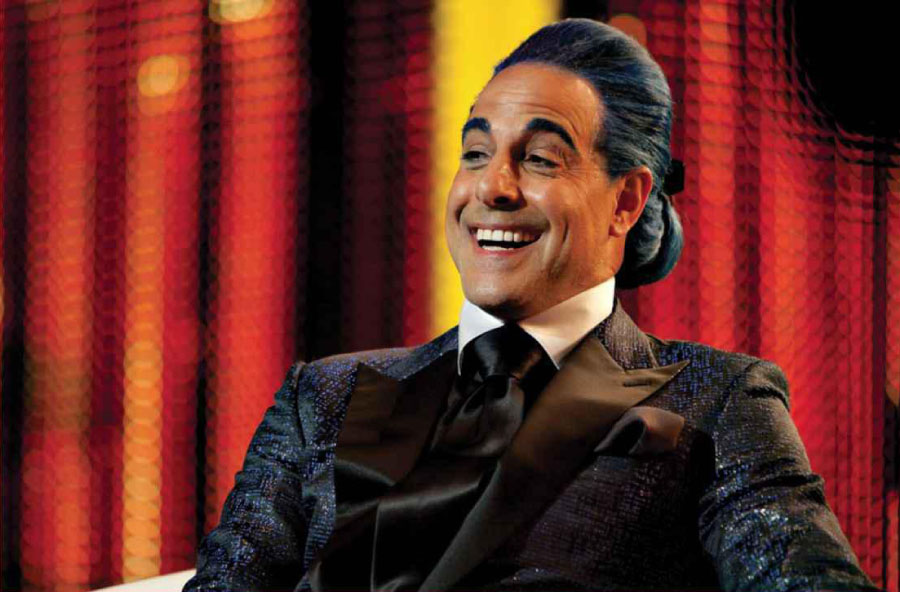
Stanley Tucci as Caesar.

My favorite minor characters in the book were Rue and Haymitch. During the movie, I smiled and laughed at every scene of Caesar, but I was still teary for Prim and Rue. It was nice to see non-tribute characters during the game.

I  left the theater at 1am with energy from the movie. The third book, Mockingjay, is higher on my reading list now and I want to read the first book again. I may watch the movie in theaters a second time.