Showing posts with label story. Show all posts

Wednesday, July 31, 2013

Divergent Isn't Much of a Dystopia

I've mentioned Divergent by Veronica Roth, but barely read it. The book series is labeled "The new/next The Hunger Games by Suzanne Collins." There are similarities, but the dystopic society in Divergent isn't as developed as in The Hunger Games. There will be spoilers in this post to explain why I think Divergent is a weak dystopia. I try to be vague.

Immediate Reaction

The beginning of Divergent felt slow and for a younger audience than The Hunger Games. I also saw a big flaw in the dystopic society. Dystopic societies are false utopias because they have flaws and usually have false intentions from rulers, but the society is typically united as a whole even if the citizens do not believe the government's proclamations.

Single belief broadcast everywhere in Equilibrium.

The dystopic society in the movie Equilibrium concluded that emotion caused war so emotion was eliminated with sedatives. They united under this envisioned utopia. Violence is used only on those who oppose.

In Divergent, separation from different races, religions, and politics is proclaimed as a cause of war. So for peace they decide to unite by values. However, they remain separated by dividing into factions with different single values. For example, the Dauntless faction live brave, but they have the aggression that Amity faction forbids. This society does not share the same vision and the new arrangement does not sound too different from before. The difference is that you live with people of same expressed thinking. You're still part of the same nation as those who are different..

Shirt design of The Hunger Games districts.
Districts in The Hunger Games have unique cultures as a result of their different production and climates. They all have the same rules from the same ruler. If one district disobeys, then all are punished. The districts are united from the same ruler and on-going punishment. To keep them from uniting into a force against the ruler, they are physically separated from each other. The government forces two children from each district to fight each other annually.

Divergent doesn't have a single ruler figure. One faction has the society's government positions as their contribution.

Factions in Divergent see each other in public areas such as school so anyone can notice the obvious differences. As different as different countries. The devoted members despise the other factions. "We are right. Those guys are arrogant. And these guys are actually ruled by greed." The factions automatically fight each otherThey don't even pretend to work towards the same goal, which is peace.

The curious ones observe and consider leaving their own faction. At age 16, everyone chooses which faction to live the rest of their life. Although choosing another faction is felt as betrayal and "Faction before family" is taught to those who change, the choice has too much freedom for a dystopic society. Someone else choosing for you or rigged test results is more dystopic.

But I Still Got Hooked

The concept of living under one value and denying yourself the rest is interesting. The freedom to choose another faction isn't dystopic, but it's interesting too.

Left to right the factions are Dauntless, Erudite,
Candor, Selfless, and Amity.
The main character, Beatrice "Tris," may seem more passive than other heroines because she was raised to be selfless, but she has attitude. She has the teen problems of not meeting family and society expectations.

I was hooked after Tris made her choice. I enjoyed her reactions to new experiences such as running for fun. The author Veronica Roth gave a good description for that example. The story became thrill action militaristic adventure now that she had to pass the initiation for the faction to accept her. This part is the majority of the book. The teen interactions reminded me of the military sci-fi Insignia.

Another problem I had though was that Tris separated herself from everyone with the label Divergent. Even after agreeing with the boy Four that we should have all the values not choose one and put down others. I felt like I was hearing, "I'm special. Who else is one of the special people like me?" instead of "We are all human. Humans cannot live limited by one value. We are all those values." Hopefully she learns in another book.


Then I Lost Interest

After the initiation, the story changed quickly. The evil mastermind and the evil plan appeared. I thought they were weak. A peer during initiation is a stronger antagonist. I lost interest in reading the rest especially as certain characters died. Their deaths were weak scenes. One event was too close to one in Mockingjay, the 3rd book of The Hunger Games.

I had hoped that these events were a simulation. That would explain the quick weak turns. That was the only way I'd be pleased, but the weak events were not a simulation. It was a short section left but I still wasn't eager to read it.

I don't know if the next book Insurgent has a thrill ride too, but I'll stop at Divergent. I'd recommend Divergent for its teen identity struggles, trials, and "What if.." concept, but not as a dystopia. I'll probably see the movie in March 2014 with friends.

Thursday, November 29, 2012

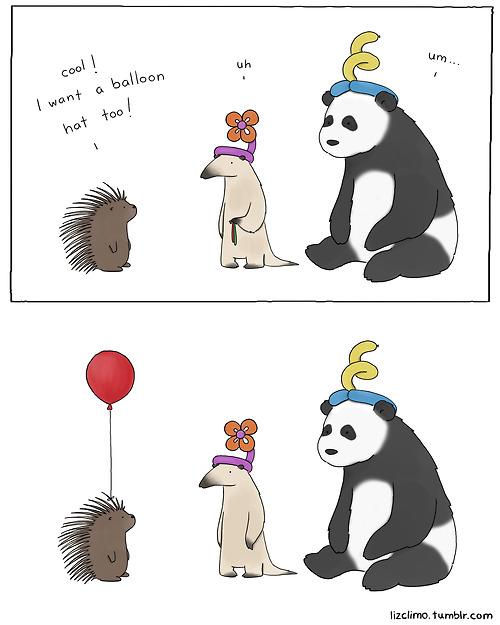
Balloon Hats

A few changes can be enough for a story.


The expressions didn't changed, but the silence is enough to express the moment. I hope you got a chuckle from this comic. :)

Saturday, May 26, 2012

The Best Story Structure

One of my favorite teachers advised to make character development the structure instead of following structure formulas. By page blah blah blah have an explosion.

The class was for screen adaptation, but the advice applies to any story. =) I improved the beginning of a story by working on the characters' journeys and goals.

Another screenwriting teacher did not believe in writer's block. She suggested to check if you strayed from the story's path at one point. Perhaps you put in a scene for its own purpose instead of the whole story's purpose. Sometimes you have to let go moments or lines. Save the draft though because you could try using that scene in another story.

Screenwriter Nicholas Meyer wanted to express his dislike of punk rock music through the time-traveling hero in Time After Time. Meyer had to omit the scene, but he rewrote it in Star Trek IV: The Voyage Home. I found the well-known scene, but the song was changed:


Saturday, March 10, 2012

Johnny Cupcakes

He's also a joker and prankster.
Last month, Johnny Earle was a guest speaker at my home community college.  His shop, Johnny Cupcakeslooks and smells like a bakery, but he sells tee shirts instead of edibles.
In 2008, he was named #1 entrepreneur 25 years and younger by BusinessWeek. Although I do not plan on running my own business or clothes line, I still found Johnny inspirational.


I will write multiple posts of Johnny Cupcakes including his advice. This post will be the longest of three or four.


His Story
Because Johnny's mother often came home upset from long hours of work and commute, Johnny decided, “I'll work at a cool company or be my own boss.” Everyone wishes for this outcome, but Johnny did more than wishing.

Johnny has been a salesman throughout his life. When he changed to a charter school, he was sad to no longer school with his friends. However, there were benefits to a small school such as easily finding the young salesman. When Johnny saw that the charter school had no yearbook, he put his scrapbook to good use. He didn't have the money for mass production, but he learned that pre-orders provided the funding.

Then Johnny learned about wholesale from buying whoopee cushions in bulk for the price of four whoopees.  Selling just four whoopees would cover the cost. 

He invested the profit into other gag products such as itching powder. Unfortunately, a student was allergic to an herb in it. When faced with expulsion, Johnny argued, “If a kid buys a pencil from a supply store and then stabs another kid, you don't blame the supply store.” Thus, he was suspended for a few weeks instead of expelled.

Because his better selection of candy sold better than the school's candy, Johnny was told to focus on the internship requirement for graduation. He looked through a phone book and chose printed shirts. At the assembly line, he was inspired him to make his own designs.

Johnny worked more internships for hands-on experience. His attitude was, “work now, play later. Put 110% into business.” As for games, Internet, and parties, Johnny said, “Don't do anything excessive.” He had to break-up with a girlfriend and one friend disappointed Johnny by not putting as much effort into a shared business. However, he still had fun with friends such as putting oral gel on their drinks so they drooled when talking to a girl.

Johnny's parents wanted him to give college a try. If he needed more time outside of school, then he could take less classes. If he took a few classes, then choose the ones he was passionate about. His parents were fine if he stopped, which Johnny did do in his first and only semester.  He was distracted by business opportunities. Johnny stated that he had Borderline ADD. He had intended to take a break from school for these ideas. 

The classic cupcake with crossbones.
His Cupcakes
Johnny randomly slapped a cupcake on a shirt. He thought a hard-core rock band member  wearing a cupcake instead of a skull would be amusing. And because people gave him Johnny-this and Johnny-that nicknames, he came up with Johnny Cupcakes.  His shirts caught the attention of coworkers and customers at a comic store. Because of all the inquires, Johnny made more shirts and sold them from the trunk of his car during work breaks.


Nickelodeon  was a dream come true
for Johnny!
His shirts became popular because there were no shirt brands focused on food. Johnny played with pop-culture by substituting characters and icons with cupcakes. Weapons were replaced with cupcakes too. The profits were invested in better supplies and equipment.

Currently, Johnny is known as not selling his product to stores, but he had done so at the beginning. He benefited in seeing store labels, tags, and packaging. Packaging alone can attract and keep customers. Johnny has spent money and time on detailing the packages he uses now to make them special. If a customer hangs onto a tag, then you get free advertising.


Johnny hard at work.
From the stores, Johnny heard about trade shows and risked his savings on a table at one. He discovered that a year's worth of networking could be done at one trade show. To stand out, he gave away cupcakes, had his team dress as chefs, and placed products on baking trays.


Johnny noticed the advantages of online shops. People buy more on the Internet than in person because they don't see each dollar leave their wallet. Customers also want to make the shipping cost worth it. In addition, items and purchases on the Internet can be shared easily. Based on a survey box, 90% of customers heard about Johnny Cupcakes from a friend. Some new customers found Johnny Cupcakes from searching “cupcakes.” Even if these people felt tricked they still spoke of the shop because the search result was different.

I got a Bobby's World vintage card.  
Because word of mouth was effective, Johnny kept people talking. Sometimes he places a random item in a purchase such as a bag of sand, a vintage sticker, batteries, or even a $20 bill. Customers share about these fun surprises and buy more shirts for more surprises. In addition, a random battery serves as free advertisement for Johnny by reminding the customer of the shirts at the sight of batteries. In his blog, he stated his excitement for when a customer finds a fake skull in their purchase. 

At the lecture, Johnny taped a little surprise under each seat. Attendees found a little bag
(like the one in the image) filled with his business card, candy wrapped with the Johnny Cupcakes logo, and a vintage trading card. One bag had $1 while another had $20. A code was also given for a 20% off discount. Johnny stated, “It's okay if you return the shirt. I just want you to see the packaging.”

This shirt that I bought had a hidden message.
Another one of Johnny's kooky strategies is a hidden message on the inside of most shirts. The shirt printers hate this extra step because most customers do not know about it. Johnny muses over a customer possibly finding the hidden message on laundry day. Johnny thinks the customer will then check other purchased shirts, call friends to check their own purchases, and buy more shirts. 


Johnny then tried a new shop location for better foot traffic. It was a risk, but over 400 dedicated customers stood in line for the grand opening. People slept 12 days on the street to buy a shirt. I will share the grand opening video in another blog post.


He got a trade dress for his shop, which means a trademark for store or product display. He won't sell cupcakes to keep his shop weird, strange, and unique. Nearby bakeries have been saved because Johnny sends the tricked, hungry customers to these shops. Another person who benefited is Johnny's mom. He hired her as CEO and she's happy now. =)


Thank you, Johnny!


I thought this real life Willy Wonka was worth standing in line three times for the lecture, shirt purchase, and face-to-face on my birthday.

Tuesday, May 31, 2011

But Stories Need to End

My last post discussed story endings in the perspective of a reader and fan. From a fan perspective, an ending can be sad because there will be no more moments of the characters.

From a storyteller's perspective, when does a story reach its ending? A story can have multiple drafts, but when are the edits final?

I have some fine artist friends who laugh when asked if they finished a painting. All forms of art can be revised.  If a writer or artist takes a break from his work, then he may spot a flaw or solution missed beforehand. However, if the creator seeks perfection for his work, then it will never be finished.

The novel The Loser by Thomas Bernhard is about a musical genius (real-life musician Glenn Gould) who sought perfection. He even dies at the piano (happened in the book but not in real life), which the narrator thought was fitting. Although one character is labeled as the loser, the reader is left to question if the other characters found success.

Glenn Gould

If you are interested in reading The Loser...
I have to warn you that the novel has no chapters or paragraphs. The prose is one body of work, and is a stream of consciousness on the history of three musicians who sought fame. The narrator repeats moments, and you will find that he changes his attitude about the moment according to his feelings.

For instance, he says he idolized his friend Glenn Gould, but then later the narrator mentions the same memory with dislike for the man who reached a higher level.  The shift in attitude after new information is revealed or admitted information is realistic and humorous, but the repetition and streaming prose can give you a headache.  You, the reader, have to be ready and have the will to stop.  Otherwise you will be overwhelmed. Perhaps the author Bernard intended the reader to share the feeling of no end with the characters.


The narrator also seeks perfection for a book. He is never satisfied with a draft, and he never creates a whole work. Because the draft is unaccepted, he destroys it and starts fresh.  He doesn't allow himself to improve and develop his skills. A story has to reach an ending for the creator to review the work as a whole and make edits for the good of the whole.

Authors have been embarrassed to read one of their previously published works because mistakes even in the plot were missed or the author felt that the work could have been stronger.  But these authors chose a point to stop and publish their work.  They allowed themselves to move on to other challenging projects or the next installment.  

A character from a TV show develops over a series of episodes instead of learning all the lessons from just one episode. 

Wednesday, April 13, 2011

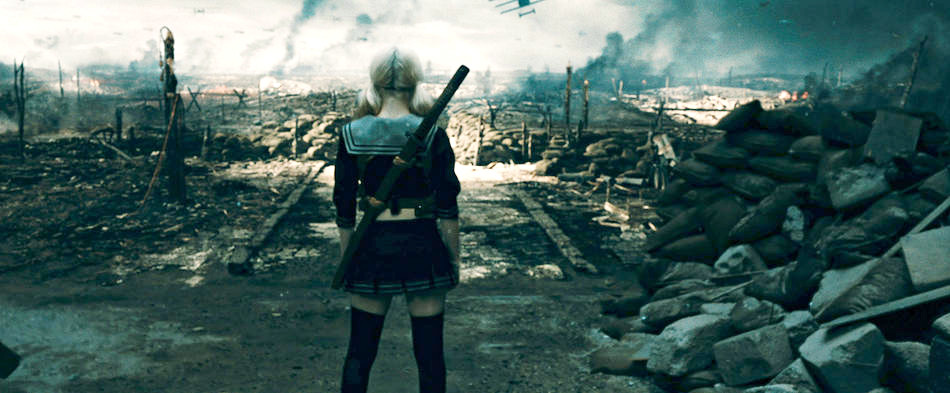
Heads up for Sucker Punch

Before I saw the movie, a friend's Facebook status read, "Sailor Moon + Inception = Sucker Punch."  I laughed but I thought Inception was associated only for having a made-up reality.  I understood better though after seeing the movie.

Here's the second trailer: 

The fighting can be seen as the made-up reality, but there's actually 3 levels to Sucker Punch (thanks buddy for the discussion).  I think the viewer needs to realize this fact early so I'll briefly state them so that the story sequence can be understood better.

1ST LEVEL (reality):
As the trailer states, the girl, "Baby Doll," loses her family and she is committed to an institute.


2ND LEVEL (This level can be confused as reality):
In the trailer and movie, you realize that the girls that were once dressed as patients later have prepped hair, make-up, corsets, and nylon like show girls.  This is the world that Baby Doll has created to push away the pain and focus on her situation. 

3RD LEVEL:
Baby doll's will to survive is shown through various fight fantasies.


Levels 1 and 2 have to be recognized as different or else the changed setting and situation only makes sense if the institute was just a front until they change back.

I want to see it again to see if certain characters exist on the first level. Any thoughts to the psychology aspect of Sucker Punch?

On a separate note, I like the movie posters and Alex Pardee's character art like the one below. =)  His other art is more dark though.


Sunday, February 27, 2011

Hemingway's iceberg - minimalistic

I mentioned Ernest Hemingway's style in a comment on my post "Personify," but the subject should be blogged. Towards the end of the post I will explain the narration of my comic strip "The Affair."


Hemingway called his minimalistic style the iceberg theory, where only 10% of the information is given.  In a story, he eliminated all that the reader can assume, leaving what the reader could not assume.  Just the essentials, or the minimum, needed to understand the story.  


David Malki, creator of Wondermark.com, has a visual example of this style improving content. The Garfield strip below is redundant through the visual and text. 
Malki states, "the punchline is set up twice and delivered twice." 
Here is Hemingway's theory of just the essentials applied to the strip:


Malki on the strip above: "It allows the reader to connect the dots, and engages them in the narrative.  It leaves room for interpretation, and for Garfield’s true thoughts to only sound in the theater of the reader’s mind."


Without the speech bubble in the first panel, the reader can interpret that Garfield's throwing the ball for fun. As soon as the Odie, the dog, is spotted, the game of catch is determined.  So redundancy killed the humor because all the interpreting work, in a reader's role, is done already, leaving  the reader no reason to linger on the story.  


For more on Garfield, look up Eric Burns who Malki referred to as the one who noted Garfield's redundancy.  Malki has more posts on newspaper comic strips in Comic Strip Doctor


In my comic strip project, "The Affair," I intended to state what the reader is less likely to determine on his/her own.  Click the image for a full view.
I never describe the affair mentioned in the title because the reader can interpret the Jack's  interest in the Queen from his shortened distance. If I state that the Jack moved closer to the Queen, then text would be redundant.  Instead I narrate the actions and feelings of the other characters which cannot be easily determined from the visual. The minor characters get their story in the captions because the main story is visible enough.


The next time a story seems to be about nothing check if you, the reader, have interpreting work to do.  


For writing, this minimalistic style is more difficult because the information is all text.  The easier cases are dialogue and description.  Do the character's repeat too much of what the narrator states?  Inner dialogue, thoughts, typically do not need to be repeated in conversation.  Having someone read your story can help to determine what can be assumed and what cannot.


Can you think of an example of this minimalistic style or a story that could use it?

Tuesday, February 15, 2011

Personify

I once tested out the filters on my camera phone in my backyard and came up with this movie trailer spoof:
I was just messing around until I saw how the first photo shown looked like a drama to me. So I messed around more to create a story.  It was fun and received laughs from family and friends.  I had also personified the animals by making them human-like in a relationship drama context.

I still like how a story can be created with anything.

In my Visual Cultures class, I found examples of personification through Edward Gorey's."The Animated Tragedy" (a page is shown below) and "Bug Book."

For my final in that class, I decided to make a comic on personified objects. Because I like the look of poker cards, I chose them as my objects. So I made a drama about cards moving closer and away from each other as a hand of cards.

I aimed to keep the captions casual and like a children's book as I saw Edward Gorey did for even his dark stories. I never mentioned the affair after the title.

For the final, I had printed out black and white.  Since then I photoshopped the images to make them more flat and give more dramatic lighting.  The piece will go in my school magazine. =)  Once again, I had fun. and I hope I do more personified works. What do you think?

If you're interested in Edward Gorey, then I recommend Amphigorey.

Monday, December 27, 2010

Meta

I've heard little about meta-narrative and meta-fiction before, but I did not understand the concepts. Then I had a week of great literature talks with three other English majors this past Fall.  I kept running into them that week, which I'm grateful for.  Meta was one of the talks (not metaphysical poetry).  

At this point, I had seen an episode of Community where the character Abed makes a meta-film. He states how he'll make a film about a film-maker who realizes his life is a film, whose film-maker will realize his life is a film too, and so on and so on. So I understood that a meta-art form worked beyond its boundaries or was layered with one form inside of another form. A film within a film. However, metanarrative is specifically a story within a story.  Metanarrative seems to also have a philosophical approach towards truth. Sounds like the inner story is the material analyzed in the outer story, which the reader himself can analyze too. I'm still trying to understand metanarrative. I know that the novel City of Glass is a example of metanarrative. I read the comicbook/graphic novel version in a class, but I have to read the story a second time.

My friends' description of meta sounded like when the story "breaks down the fourth wall," goes beyond its boundaries, and speaks directly to the reader about its form.  Soo I now see a meta-art form as being conscious of itself and commenting on the form.  Going with Community again, the character Abed makes the show meta. He comments on what the episode is parodying.  He even once stated how his commentary is his gimmick as a character.  This aspect of the show is one reason why I watch Community.  My friends helped name and define one of my interests.

This week I got my sister to watch one of my childhood movies, The Neverending Story, which I had a feeling was Meta.  (SPOILER ALERT)  The movie has a metanarrative because it's a story within a story, following a boy reading a book of the same title.  The experience explored is the connection between the reader and protagonist.  A reader follows the protagonist's journey, feeling and suffering with him.  That's why Atreyu saw Bastion in the mirror.  Also think about this: Atreyu's journey depended on Bastion's determination to continue reading the story.  Bastion is the one continuing and pushing the story.  

You can compare this movie to The Princess Bride with the boy's interest in continuing the story, but the only influence he had was whether the audience of the movie would see more the story.  The characters do comment a little on the inner story though like with the expectation of a hero vanquishing the villain.  I would like to have a metanarrative with the protagonist knowing that he lets the reader see the inner story.

Back to The Neverending Story with my sister and I as the audience,  I kept mentioning a wolf scene so when the part came, she seemed disappointed that it was mostly talk.  I'm glad she continued to watch the movie though.  It is mostly talk and shots of Bastion reading, but I like the metanarrative.  I also love the Swamp of Sadness. If you let sadness overtake you, then you will sink. So basically you give up in this journey that needs determined heroes/readers to continue the story. I read somewhere that there was a book before the movie and I found out that the movie only covers half the story.  I'm adding the book to my list to see more of the metanarrative commentary. The second half of the book seems to be the movie sequel but the book ends differently.

Another book on my list is a comic/graphic novel called Unwritten. I've only read a few pages so far but I like what I've read that the story's about.  It covers fanatic fandom for a series that's like Harry Potter. I am interested in fandom.  How a story impacts a fan greatly, the arguments among fans of different stories, and the harm of escapism when not accepting reality. Unwritten also seems to be meta with the boundaries of story and reality, but I think the commentary is more on the fans.  The series is three volumes, with the third one coming out in March.

Maybe I'll have another entry about Meta or at least about Unwritten when I've read more of it.